.png)
When image quality becomes a priority, finding the perfect TV isn't easy. Sony knows this, and with the launch of the BRAVIA 5, it is betting strongly to lead the Mini LED TV segment in 2025. This model promises a visual experience of extremely high precision, vibrant colors, and blacks deeper than ever, thanks to an improved lighting system and truly advanced contrast management.
The competition in this segment is fierce, with brands like Samsung, LG and TCL presenting increasingly sophisticated proposals. However, Sony has managed to leverage its experience in image processing and design to deliver a product that not only stands out for its technology but also for its elegance and premium build.
In this comprehensive review of the Sony BRAVIA 5, we will analyze every detail that makes it one of the most anticipated TVs of the year: from the Mini LED panel quality and performance in dark scenes, to the built-in sound, the Google TV operating system and the smart features designed for cinema, gaming and everyday use.
Is it really up to the expectations? Does it deserve to be called the best Mini LED TV of 2025? Let's find out.
Smart and minimalist design: this is how the Sony BRAVIA 5 feels from the first glance
Right out of the box, the Sony BRAVIA 5 makes it clear that it doesn't seek to call attention with unnecessary adornments. Its aesthetic proposal is sober, elegant and focused on what really matters: delivering an immersive experience where the screen is everything. In a market saturated with designs that try to stand out on their own, this TV bets on something much more sensible: becoming a discreet window that disappears while you enjoy the content.
The first impression when handling it is decisive. The BRAVIA 5 not only looks good, it also conveys robustness. Its weight and density require that unboxing be done by two people, but this is not a drawback; on the contrary. It speaks of a solid, well-built product. When you press its edges, there are no creaks or sense of fragility. The metallic frames, in a very discreet matte black, practically blend with the image when you are at a normal viewing distance. The result is a sense of an infinite screen, where the technology disappears and the content takes center stage.
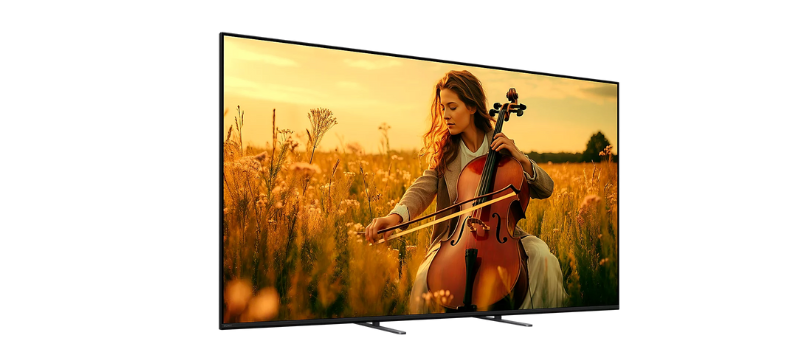
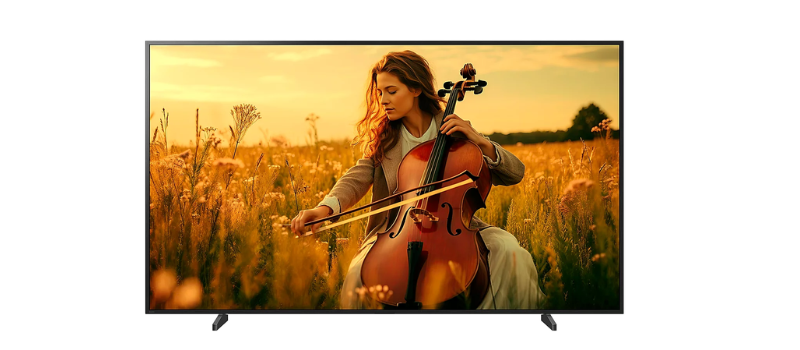
One of Sony's smartest decisions has been the stand system, called Underlay Stand. C with a wedge-shaped metallic design, it allows two mounting positions. In the first, the legs are placed at the extremes to offer maximum stability and a very stylish look. Ideal if you have a long piece of furniture. But if space is limited — something very common in small apartments — they can be mounted closer to the center. This makes it easier to place the TV even on smaller tables, without losing stability or aesthetics. It's a detail that makes a difference in day-to-day use.
As for thickness, it's clear we're not looking at an ultrathin OLED panel. The BRAVIA 5 incorporates Mini LED technology, which requires a bit more space for the backlighting system. Still, it maintains a uniform profile of between 5 and 6 centimeters. Not exaggerated. Personally, I find this type of design cleaner and more structured than those models that are ultra-thin on top and hide a large bulge at the base. Moreover, this constant thickness simplifies wall mounting: it is compatible with VESA 300x300 mounts and, if you use a slim one, it can sit quite close to the wall without protruding too much.
An extra that doesn't go unnoticed is that the Sony BRAVIA 5 includes two remote controls. One is modern and minimalist, with direct access to the most-used streaming apps (including Sony's, which surprises with free content like 28 Days Later). The other, more traditional, retains the classic layout with a numeric keypad, perfect for those who prefer the traditional control experience, or for older users who feel more comfortable with clearly defined physical buttons.
Stunning image quality: the BRAVIA 5 dazzles with visual intelligence
Not all TVs shine equally, and certainly not all know when to stop shining. In this balance of light and shadow is where the Sony BRAVIA 5 earns the respect even of the most demanding. The key? A combination of cutting-edge Mini LED technology and the most advanced image processing Sony has developed to date. The result is simple to describe, but hard to forget: an image that looks insanely good.
To understand why this TV looks so good, you have to start with the backlight system. While a conventional LED TV barely has a few large bulbs behind the panel, and a Full Array goes up to dozens distributed by zones, the BRAVIA 5 plays in another league: thousands of tiny Mini LEDs distributed with surgical precision. These are grouped into independent zones — the exact number Sony does not disclose — but the important thing is how they are used, not just how many there are.
And this is precisely where the crown jewel comes into play: the XR Backlight Master Drive, Sony's own algorithm to control those zones with millimeter precision. Other TVs may have many LEDs, yes, but if the processor isn't fast or smart enough, the result is unwanted effects like light halos, flickers, or blurred images in high-contrast scenes. The BRAVIA 5, on the other hand, manages the illumination so effectively that blooming is reduced to a minimum. It still exists, because no non-OLED TV can eliminate it entirely, but you have to look very closely and have the room completely dark to notice it. In real conditions, it is practically imperceptible.
What really surprises is how this model handles complex scenes: white text on dark backgrounds, aggressive backlighting, moving images. Everything looks sharp, with no light bleed, with deep and natural contrast. And it's not just about brute power, but an intelligent interpretation of the image. Sony doesn't want to dazzle you with gaudy colors or blinding whites; its aim is that you see every detail, even in the brightest parts of a scene. Here tone mapping and Triluminos Pro come into play, providing a rich color palette, without excess, where human skin tones, fire, water, or bright skies maintain texture and realism.
Another area where the BRAVIA 5 shines — and a lot — is low-quality content, something quite common in Spain, where DTT and certain streaming services still broadcast in modest resolutions. Thanks to the XR Processor and its Clear Image function, the TV detects these low-resolution signals and improves them noticeably. It cleans digital noise, corrects jagged edges, reconstructs details, and smooths compression artifacts. Watching a news program or a football match on this TV is, literally, another experience. This is where processing makes the difference with other high-end models, which simply scale the image without applying any real enhancement.
Now, not everything is perfect. The panel mounted on this BRAVIA 5 is VA-type, which ensures excellent contrast when viewed head-on, but viewing angles are somewhat limited. If you have a large L-shaped sofa and you're in a corner, colors may lose strength and blooming may be more noticeable. It's a common compromise in VA panels, although Sony has mitigated it quite well.
Finally, we must talk about glare management. The semi-matte finish of the panel helps diffuse direct light sources, such as lamps or windows, but it doesn't work miracles. If you have a large window right in front of the TV, you'll see diffused reflections. The good news is that, thanks to its high brightness, the BRAVIA 5 performs well even in bright rooms, outperforming many OLED panels in this respect, which tend to wash out visually under a lot of ambient light.
Limited connectivity: the Achilles' heel of the BRAVIA 5
No matter how spectacular the image of a TV is, there are details that cannot be overlooked, especially when talking about high-end gear like the Sony BRAVIA 5. One of those weak points —and probably the most evident— is the distribution and number of ports. In 2025, where homes are packed with devices, next-gen consoles, soundbars and media centers, one would expect something more.
Let's get to the point: this model includes four HDMI ports, of which only two are HDMI 2.1, that is, the only ones that allow playing 4K at 120Hz with features such as VRR (Variable Refresh Rate) and ALLM (Auto Low Latency Mode). The other two are HDMI 2.0 ports, suitable for standard content, but insufficient to fully exploit the capabilities of a PlayStation 5, an Xbox Series X or a modern gaming PC.
The problem worsens when you consider that one of the HDMI 2.1 ports is reserved for eARC, i.e., to send high-quality audio to a soundbar or home theater system. And to be honest, nowadays few users are content with the built-in audio of a TV, no matter how good it is. In practice, this leaves only one functional HDMI 2.1 port for high-performance gaming.
And if you have both next-gen consoles, you have to choose, or even worse: stand up, disconnect and swap cables like in the 90s. This limitation, which is inherited from previous Sony models, is due to the MediaTek chipset the brand continues to use and which, unfortunately, imposes this technical restriction. And on a TV that costs over 1,300 euros, it's a point hard to justify, especially when we look at the competition. Brands like LG or Samsung already offer four HDMI 2.1 ports on their equivalent models, giving the user much more freedom.
Beyond HDMI, there are also two USB ports, one of them with 3.0 standard, useful for recordings or external hard drives. It also includes a digital optical output for more traditional sound systems and an Ethernet port that, to many's surprise, remains limited to 100 Mbps. It's an unnecessary bottleneck, although the built-in Wi-Fi 6 compensates for this shortcoming for most users.
That said, and this must be stated clearly: gaming on the BRAVIA 5 is a real delight. Just connect a PS5 for the TV to recognize it immediately and automatically adjust tone mapping, resulting in vibrant yet balanced colors, perfect for demanding titles like God of War: Ragnarok or Red Dead Redemption 2. Input lag is low, the motion is flawless, and the experience, simply, hooks you.
So yes, the BRAVIA 5's connectivity is improvable — and quite so — but when it comes to gaming, it performs well. The problem is that for those with more than one latest-generation device, these limitations can be frustrating. In a TV so well designed and with such spectacular image quality, this technical detail leaves a bittersweet taste.
Sound that performs... but doesn't surprise: the usual weak point in flat TVs
Although Sony pays special attention to the sound department of its TVs, the BRAVIA 5 does not escape a common reality in almost all models on the current market: the sound, although correct, is not up to the rest of the package.
This model includes the Acoustic Multi-Audio system, a technology that aims to recreate a more immersive feel without resorting to external systems. Since the Mini LED panel cannot be vibrated as in the brand's OLEDs, the solution is to include two positioning tweeters on the sides of the frame, strategically placed at ear level. Added to that are the full-range X-Balanced speakers, located at the bottom of the TV.
The goal? Trick the brain into perceiving that voices and sounds emerge directly from the center of the screen. And, partly, it achieves it. Dialogues sound clear and well defined, especially thanks to Voice Zoom 3, powered by artificial intelligence. This tool allows highlighting voices without amplifying background noise, ideal for watching movies at night or for people with hearing difficulties.
However, when it comes to powerful bass or action scenes, the physical limitation of the ultra-thin design is noticeable. Explosions lack depth, the music sounds somewhat hollow, and there isn't that sonic "impact" you expect in certain scenes. A soundbar is almost essential if you want to enjoy a complete experience. It is not a defect exclusive to this model, but a logical consequence of the design of modern TVs.
Conclusion: a TV that not only impresses, but convinces
After thoroughly testing the Sony BRAVIA 5, it is clear that we are looking at one of the best Mini LED TVs of 2025. Its sober and functional design, the truly spectacular image quality, and a signal processing that continues to make a difference, position it as a safe bet for those seeking a high-end visual experience in a premium LED TV.
The contrast management, bloom control, well-calibrated brightness and realistic colors make watching movies, series or playing video games a real pleasure. In addition, Dolby Vision adds a plus in dark scenes and HDR content, further elevating immersion in compatible movies and games.
In this sense, it is an excellent option for those looking for a 65-inch TV with high-end features. And although the sound remains the weak point — as with almost all flat TVs — it is easily compensated with a good soundbar.
Does it have room for improvement? Yes. Especially in connectivity, where more HDMI 2.1 ports are missed. Still, if you don't need to connect multiple devices simultaneously, and you value visual quality, HDR compatibility, and integration with services like Sony Pictures Core, the BRAVIA 5 is a purchase that hardly disappoints.
And if you're comparing with other models like the BRAVIA 7 or the BRAVIA 9, you should know that this version finds a perfect balance between features, design and price.