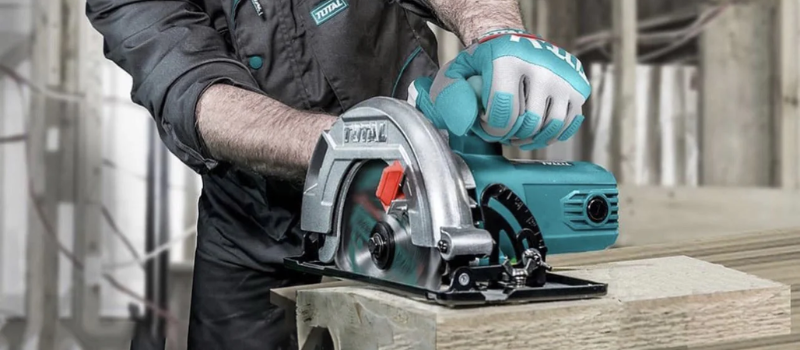
The firm sound of a circular saw in action has something almost hypnotic: it cuts, guides, and transforms wood with precision. For those who work in carpentry, DIY, or construction, having the right tool is not just a matter of convenience, but of efficiency and safety. Over the years, circular saws have evolved, incorporating technology that enables cleaner cuts, more powerful motors, and safety systems that protect even the least experienced users.
However, the wide variety of models available can be overwhelming. Each saw promises speed, precision, and durability, but the real differences are often found in technical details, such as cutting depth, blade stability, or the ease of adjusting angles. Therefore, it's not just about choosing a popular model or one with the best reviews; understanding what's needed and how each feature impacts daily work makes the difference between a perfect cut and a frustrating effort.
This article offers a comprehensive comparison of the best handheld circular saws of 2025, analyzing performance, ergonomics, safety, and value for money. The idea is to guide you step by step, revealing advantages and limitations of each model, so that making an informed decision is easy and reliable, without wasting time or money on tools that don't fit your real needs.
What is a Circular Saw and What is it Used For?
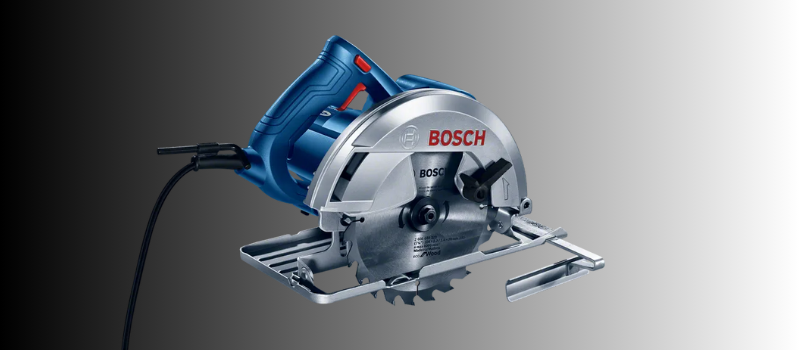
A circular saw is much more than a cutting tool; it is a device designed to transform materials with precision and speed, enabling everything from simple cuts to complex carpentry or construction work. Unlike manual circular saws, its rotating blade makes straight, uniform cuts, adapting to different types of wood, light metals, and composite materials. Whether it's a mini circular saw for small projects or a high-performance professional circular saw, its versatility makes it an indispensable ally for both professional use and a DIY project, ensuring clean and efficient results. Among the best-known brands, a Bosch circular saw stands out for its durability and precision, while models like the Hychika mini circular saw are ideal for portable and domestic work.
Main Features of a Circular Saw
Blade types and power
Circular saws vary according to blade type and motor power. Some blades are designed for soft or hard wood, while others allow cuts in metal or plastic. The motor power directly influences cutting capacity: the more robust models withstand continuous work, while portable or mid-range ones are ideal for domestic tasks or DIY projects. Choosing the right blade and motor combination ensures precise and durable cuts on any cutting line. Moreover, choosing an appropriate saw blade allows adapting the tool to different materials, optimizing performance and safety.
Ergonomics and ease of use
The design of the circular saw also seeks comfort. Non-slip handles, weight balance and precise depth adjustments or angle adjustments are fundamental to reduce fatigue and increase safety. A well-designed portable circular saw allows greater control and precision, avoiding mistakes that could ruin the material or cause accidents. Handheld mini circular saws stand out for ease of handling in tight spaces, while benchtop circular saws offer stability for longer and more complex cuts.
Common Uses in Carpentry and Construction
Cutting wood, metal and composite materials
Circular saws are not limited to cutting wood; with the correct saw blade, they can also work metal, MDF, particle board and other composite materials. This broadens their usefulness, making them versatile tools for different types of projects. Whether it's a handheld circular saw or a professional model, the ability to adapt to different materials is a decisive factor when investing in a quality tool.
Professional vs DIY applications
In professional settings, Bosch circular saws or equivalent models are used for continuous work, precise cuts, and projects that require efficiency. For the DIY project, handheld or portable circular saws offer comfort and ease of use, allowing you to perform domestic tasks or creative projects without complications. In both cases, the right selection of the circular saw guarantees a balance between power, precision, and safety, ensuring professional results even for those without advanced experience. Additionally, having a benchtop or portable circular saw according to the project's specific needs improves efficiency and reduces errors in each cut.
How to Choose the Best Circular Saw in 2025
Choosing the right circular saw among the different types of saws can make the difference between a successful project and a frustrating one. It's not just about the most recognized brand or the most expensive saw, but about evaluating a combination of factors that directly impact performance, safety and comfort during use. In this guide, we break down the most important aspects to help you make an informed decision.
Power and Speed
One of the first elements to consider is the motor power and the speed at which the blade rotates. Power is measured in watts or amperage, while speed is indicated in revolutions per minute (RPM). A saw with higher power and RPM can cut denser materials and perform continuous cuts without losing efficiency, ideal for professional projects or intensive tasks. On the other hand, if your work is more occasional or domestic, a model with lower power may be sufficient, offering also a lighter and easier-to-handle operation. The key is to balance power and control: too much force without stability can be uncomfortable or even dangerous, while too little power can cause irregular cuts or overheating of the tool.
Precision and Cutting Depth
Another decisive factor is precision and cutting depth. Circular saws allow adjusting blade height and cutting angle, which directly influences the finish quality. A clean cut is not only aesthetically more attractive, but also reduces the need for sanding or corrections later. Moreover, the cutting depth affects safety: a blade too exposed increases the risk of accidents, while a proper adjustment provides full control over the material. Models that allow fine and repeatable adjustments offer advantages for both experienced users and beginners who seek consistent results.
Safety and Comfort
Safety is an aspect that cannot be overlooked. The best circular saws include quick-stop braking systems that stop the blade when the trigger is released, guards that cover the blade and prevent accidents, and ergonomic grips that reduce fatigue during long sessions. Comfort is also key: a well-balanced saw, with weight distributed correctly and non-slip grips, allows maneuvering it with precision, even in complex cuts or heavy materials. The combination of safety and comfort not only protects the user, but also improves efficiency and confidence when working.
Value for Money
Finally, value for money is a fundamental criterion. Low-end circular saws are often affordable and useful for light tasks, but they may lack power and durability. Mid-range models offer a balance between performance, versatility, and price, ideal for demanding hobbyists or professionals with moderate budgets. Finally, high-end ones stand out for robust materials, powerful motors, exceptional precision and advanced features, recommended for intensive professional use. Assessing your real needs and comparing features against price will allow you to invest wisely, avoiding overspending on features you may never use.
Choosing the right circular saw involves analyzing each of these aspects: power, speed, precision, safety, and value for money. By doing so, you guarantee not only optimal performance, but also safe, efficient, and satisfying work, tailored to any project—from domestic tasks to complex professional projects.
Comparison of the Best Circular Saws of 2025
Choosing the right circular saw isn't always easy. Each model offers different features, powers, and functionalities, so comparing pros and cons before making a decision is essential. Below, we analyze five of the most notable circular saws of 2025, evaluating performance, ergonomics, safety, and value for money.
Makita 5007F
Main features:
- 1,500 W motor with variable speed up to 5,800 RPM.
- 190 mm blade diameter, suitable for wood and composite materials.
- Electric brake system for greater safety.
- Compact design and ergonomic grip.
Pros:
- Powerful and consistent for deep cuts.
- Excellent precision and stability during use.
- Durability recognized by users and professionals.
Cons:
- Somewhat high price compared to mid-range models.
- Heavier, which can cause fatigue on prolonged cuts.
Approximate price: 200 – 250€.
Bosch GKS 190
Main features:
- 1,400 W motor and speed of 5,300 RPM.
- 190 mm blade with cutting capacity up to 70 mm at 90°.
- Built-in dust extraction system.
- Bevel base for angled cuts and optional laser guide.
Pros:
- Clean and precise cut, even in hard wood.
- Good balance between power and lightness.
- Advanced safety features, ideal for professional DIY.
Contras:
- Not as powerful as high-end models for heavy continuous work.
- Additional accessories, such as the laser guide, are sold separately.
Approximate price: 180 – 220€.
DeWalt DWE575K
Main features:
- 1,350 W motor and 5,200 RPM.
- 184 mm blade, lightweight and easy to handle.
- Electric brake system and non-slip grip.
- Carrying bag included and quick depth adjustments.
Pros:
- Compact and very easy to transport.
- Ideal for DIY tasks and home projects.
- Excellent ergonomics and comfort during prolonged cuts.
- Cutting depth limited compared to larger models.
- Not recommended for continuous work in thick wood.
Approximate price: 160 – 200€.
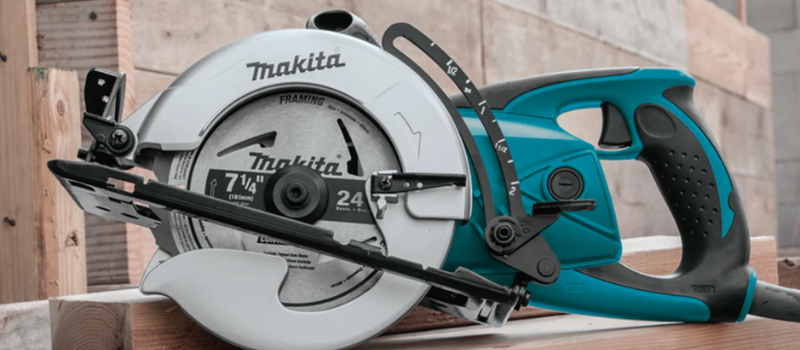
Makita HS7601
Main features:
- 1,200 W motor with a constant speed of 5,200 RPM.
- 165 mm blade, lightweight and manageable.
- Adjustable aluminum base for precise angled cuts.
- Safety system with fast blade brake.
Pros:
- Light and very easy to control, ideal for beginners.
- Excellent precision in straight and angled cuts.
- Favorable value for money.
Contras:
- Power limited for very hard materials or continuous projects.
- Fewer accessory options compared to high-end models.
Approximate price: 120 – 160€.
Hitachi C7SB3
Main features:
- 1,500 W motor with 5,800 RPM.
- 190 mm blade with cutting capacity up to 70 mm at 90°.
- Robust aluminum base and precise angle and depth adjustments.
- Optional dust extraction system and electric safety brake.
Pros:
- Powerful and durable, suitable for intensive professional use.
- Stable and precise cut even in thick wood.
- Very good value for money within its category.
Contras:
- Weight is somewhat high, it can be less comfortable for long tasks.
- Extras like guide and bag are sold separately.
Approximate price: 190 – 230€.
Conclusion: Which is the Best Circular Saw of 2025?
After analyzing the main circular saws on the market in 2025, it is clear that each model has its strengths and is designed for different types of users and projects. The Makita 5007F and the Hitachi C7SB3 stand out for their power and durability, ideal for professional work and continuous projects that require precise and consistent cuts. For its part, the Bosch GKS 190 offers an excellent balance between performance, ergonomics and precision, becoming a versatile option for those seeking a reliable tool without investing in high-end models. For DIY enthusiasts or those who perform occasional home tasks, the DeWalt DWE575K and the Makita HS7601 represent lightweight, easy-to-handle alternatives with a very attractive value-for-money.
When choosing the best circular saw, it is essential to consider your real needs. For a professional user, the priority should be power, durability, and precision, even if it means a higher upfront cost. DIY enthusiasts will benefit from compact and comfortable models that facilitate clean cuts without hassle. Those seeking a tool for occasional use can opt for mid- or low-range saws that handle domestic tasks or occasional projects without sacrificing safety or quality.
Ultimately, there is no single “best circular saw” for everyone. The choice depends on factors such as the type of material to cut, frequency of use, the importance of ergonomics, and, of course, the available budget. Carefully evaluating each feature and comparing models according to your working style will ensure the investment is efficient and that the tool becomes a reliable ally in every project.
The next step is to analyze your priorities: define which features are essential, set a budget range, and review the options that best fit those criteria. With this information, selecting the right circular saw will be much easier, safer, and more satisfying, ensuring precise and durable results in all your cuts.



.png)